
The New Dress
Summary of The New Dress Introduction “The New Dress” is Virginia Woolf’s short story about Mabel Waring, who attends a social gathering wearing a new yellow dress. The writer’s technique of stream of consciousness allows us to peep into Mabel’s mind and follow her chain of thoughts. Mabel is wearing a yellow dress that she designed with her dressmaker specifically for this particular occasion. She has taken an image from an old fashion magazine from Paris and has spent countless hours with her dressmaker attempting to get the design just perfect for this social gathering, where she wishes to make an image of perfection of herself. to the Party On receiving an invitation from Mrs. Clarissa Dalloway, Mabel prepares to attend the party. She spends hours with the dressmaker to choose a dress. After much thought and elaborate discussion, she decides on a yellow dress. But as soon as she enters the party, a sense of self-doubt takes such a strong grip over her mind that she keeps wondering whether or not she looks good enough. The Beginning of the Doubt Mabel believes that to be fashionable in London society requires a good fortune. She believes she can never be fashionable. As soon as she enters Mrs Dalloway’s house, she meets Mrs. Barnet. Mabel interprets the look on her face to be a look of disapproval of Mabel’s dress. Her confidence is shaken and on being greeted by the host of the party, Mabel grows more suspicious of her decision of wearing that dress. A final look into the mirror confirms that Mabel looks unfashionable and that her dress is not appropriate. Mabel’s Past Life Worrying so much over a dress seems a trivial matter until we get a peep into Mabel’s mind. Her thoughts reveal that her past life has not been easy. Mabel’s lack of confidence and her excessive self consciousness begin to make sense when we get to know the kind of childhood she had. Money had always been scarce in her childhood and her family had struggled to make the two ends meet. A series of misfortune had aggravated the troubles of her poor family. Due to this, Mabel had never had an access to the high fashion of the society. Mabel’s married life had not made things any better and she lives in a small house with her husband Hubert and their two kids. They have no maids and can only afford bare minimum food. The Cause of Mabel’s Insecurities Mabel’s modest family background explains the sense of inferiority that constantly troubles her. However, she remains aware of the fact that the opinions of others or their approval should not be a matter of her concern. Despite knowing that she lacks conviction, she fails to free herself from the inferiority complex. This is because she has deeply ingrained the class differences that mark certain people as superior to others. She nevertheless tries hard to fit in into the high fashion society of Mrs Dalloway, but fails miserably. The Fly in the Saucer Mabel likens her condition to that of a fly trapped in a saucer. As much as she detests this image, it is stuck in her mind. She remembers having read it somewhere and the image of a fly trying to crawl over the edge of a saucer now seems like her own situation. Due to a lack of self-worth, she pictures herself as a poor, miserable fly while the other people at the party seem to her to be dragonflies, butterflies or beautiful insects. Mabel is so consumed by her insecurities that she sees herself as inferior to everyone. Mabel’s Need for Validation Dressed in her pale yellow silk dress, Mabel grows highly unsure and begins to suspect that people are mocking at her. She therefore initiates conversations with some people in hopes of getting a compliment or validation. Her anxieties are further heightened by guests like Charles Burt. Rose Shaw’s words of praise seem pretence to Mabel. All praise seems mere pretence to her. Every compliment she receives is dismissed by her as merely an act of politeness. Seeing Charles Burt and Rose Shaw engaged in a conversation, Mabel assumes they are making fun of her yellow dress. She is further disconcerted by Mrs Holman who approaches her but talks only of her children’s ailments. The Yellow Dot Seated uneasily on a blue sofa, Mabel sees her reflection in a mirror. She sees herself as a yellow dot. This is the result of a complete absence of regard for herself and her worth, that makes her see herself reduced to mere dot. Her diminshed reflection in the mirror symbolises the incompetent and worthless person that Mabel has reduced herself to. By constantly overthinking and doubting, she has begun to consider herself inferior to others like Rose Shaw or Mrs. Dalloway. She believes that she is an unsatisfactory mother and a wobbly wife. Mabel’s Resolution After a chain of conflicted thoughts trouble her during the party, she resolves to be a changed person and transform her life for better. But very soon, the determination fades away. Wrapped in her old Chinese cloak, Mabel Waring leaves the party early. Conclusion Mabel’s insecurities stem as much from her self-conscious thoughts as from her low social standing. She constantly feels out of place during parties but keeps attempting to fit in. She leads an unsatisfactory life at home and considers herself worthless. This is a woman trapped in the modern dilemma of identity. She dwells so much on her dress and cares too much for the opinions of others about herself. Thus, Mabel Waring is an unfortunate figure who is the victim of her obsessive thoughts. She desperately tries to elevate herself to the social standing of the high class but fails. She is an alienated, lonely figure who is a victim of her own thoughts and of the class differences that she tries to efface. Click to contact us 9822716201 arsodyogiraj@gmail.com 4, Dewkinandan, Shinde

Novel 4.4
Describe in brief the importance of the places (a) London Ans: Sherlock Holmes, Dr. Watson, Miss Mary Morstan, and the anonymous sender of the letter − all live in London. Though there are references about India in the extract, but most of the events happen in London where two different sides of London have been shown first is fashionable like Lyceum Theatre frequented by the wealthy crowd and the unfashionable suburban Landon, lined with dull brick houses and third rate two-storied villas. Finally the story ends up in London. (B) Lyceum Theatre Ans: The Lyceum Theatre is important in the extract because the anonymous sender of the pearls requests Miss Mary Morstan to meet with him at the third pillar from the left outside the Lyceum Theatre. This is the place that promises to unfold the mystery of the anonymous sender and reveal the story of how Mary is a “wronged woman”. It is a fashionable area of London where wealthy people frequently visit. (C) Edinburgh Ans: Mary Morstan’s father was an officer in an Indian regiment. He sent Mary to England when she was still a child. As a motherlesschild who had no relatives in England, Mary was placed in a comfortable boarding establishment in Edinburgh, where she lived till she was seventeen. This place is important because Mary Morstan, one of the major characters in the story, spent her childhood there. (D) Agra Ans: Though there is no direct mention of Agra in this particular extract, but the treasure due to which all the actions occurs in the story comes from Agra. The pearls that Mary receives, are from a chaplet that was a part of the Agra treasure and the piece of paper that Mary gives to Holmes is the blueprint of the Agra Fort, where the treasure had been hidden. (E) Andaman Islands Ans: The Andaman Islands are referred twice in the given extract − once when Mary reveals that her father, Captain Morstan, was one of the officers in Andaman Islands; and the second time when she discloses that Major Sholto, her father’s friend, was also in the Andaman Islands. In the context of the novel, the Andaman Islands are vital to the story. New The New Dress Novel 4.4 History in today 6 Dec Click to contact us 9822716201 arsodyogiraj@gmail.com 4, Dewkinandan, Shinde Plots, Yavatmal. Whatsapp Us Follow Us Thanks for Visiting

History in today 6 Dec
1732 Warren Hastings, the first Governor General of the East India Company, was born. 1877 Washington Post publishes 1st edition 1882 Atmosphere of Venus detected during transit 1897 London becomes the world’s first city to host licenced taxicabs 1907 The first incident of dacoity related to India’s freedom struggle took place at Chingaripota railway station. 1912 China votes for universal human rights. 1929 Turkey introduces female suffrage. (Right to vote) 1956 Constitution builder Dr. Babasaheb Bhimrao Ambedkar died. 1956 Randhir Singh Gentle scores the winner as India beats Pakistan, 1-0 in the Melbourne Olympics field hockey final to win it’s 6th consecutive gold medal in the sport 1957 1st US attempt to launch a satellite fails-Vanguard rocket blows up 1967 USSR performs nuclear test at Sary Shagan USSR 1984 France performs nuclear test 1987 MiG-29 joined the Indian Air Force, renamed ‘Baz’. 1988 Nelson Mandela is transferred to Victor Vester Prison, Capetown 1992 Babri Masjid in Ayodhya was demolished by fierce Hindu kar sevaks. After this, riots broke out in many states of India. 2006 NASA reveals photographs taken by Mars Global Surveyor suggesting the presence of liquid water on Mars 2020 US President Donald Trump orders about 700 troops withdrawn from Somalia 2022 There are many such incidents which we probably do not remember. What events have happened in the history to this day. How was history today? What happened history today? What happened today history? How was the history to date? Have tried to talk about this. Next Click to contact us 9822716201 arsodyogiraj@gmail.com 4, Dewkinandan, Shinde Plots, Yavatmal. Whatsapp Us Follow Us Thanks for Visiting

Important Historical events of 5th December
Years Events 1955 The STD service that provides long distance telephone calls to every home came into existence on this day in 1955. 1971 India recognized Bangladesh as a country 1950 Freedom fighter and philosopher yogi Arvind Ghosh died in Puducherry 1999 Yukta Mukhi took the title of Miss World to her name 1950 Sikkim became the protected state of india 1657 Shah Jahan’s younger son Murad proclaimed himself king 1969 The birth of Anjali Bhagwat , The famous shooter 1931 Gandhiji leaves England for India 2000 Postal staff go on nationwide indefinite strike which the government termed as illigal 1901 The birth of Walt Disney HSC Examination Countdown! DaysHoursMinutesSeconds 9822716201 arsodyogiraj@gmail.com 4, Dewkinandan, Shinde Plots, Yavatmal. Latest Posts History in today 6 Dec Important Historical events of 5th December The Sign of Four Around the World In Eighty Days To Sir With Love – 2 Elementor #2155 To Sir With Love Mahatma Jyotiba Phule confusing words – 6 confusing words – 5
The Sign of Four
Describe the characters 1] Describe the character of Mary Morstan from Dr. Watson’s point of view. Ans: Mary Morstan and Dr. Watson meet each other the first time when she comes to take the help of Sherlock Holmes in a case. Dr. Watson describes Mary as very young attractive woman with a deep, rich-toned voice, graceful, well-gloved lady. who is impeccably dressed in a sober, greyish, pale plain and simple dress with a dull turban that has a white feather on the side which suggests that she is a woman of limited means. Her aspects of face are not regular and her complexion is not bright, but her expression is sweet and friendly and her large blue eyes are remarkably spiritual and sympathetic. Dr. Watson even describes her emotional state of mind as agitated, because he witnesses her lip tremble and her hand quiver as she takes her seat. Dr. Watson finds Mary is not feeling uneasy about her strange situation, but she displays perfect self-control driving to the Lyceum Theatre. 2] Sherlock Holmes is the leading character in the extract. Explain. Ans: The main character in the novel is the private detective, Sherlock Holmes. He is presented through the viewpoint of his friend, Dr John Watson, the narrator of the story. At the beginning of the extract, Miss Mary Morstan comes to meet Sherlock Holmes with a case. Through her conversation with Holmes and during their conversation Dr. Watson wants to leave from there so that she does not feel an embarrassing one and after listening to Miss Morstan’s story, Holmes is the one who questions her further. This helps the reader understand Holmes’ importance in the extract, It shows, Holmes is the leading character in the extract. 3] Dr. Watson, the narrator, is one of the major characters in the novel. Illustrate Ans: Dr. Watson is the narrator of the story and Sherlock Holmes’ loyal assistant. He is a doctor by profession whose insightful narration helps the readers experience the story through his eyes. He is the second-most important character in the story, after Holmes. This is because he helps Holmes to understand the sensitive aspects of situations, which is not Holmes’ strong suit (side). All the qualities attributed to Dr. Watson, along with his relationship to the protagonist, Sherlock Holmes, and his narrative viewpoint, make him one of the major characters in the novel. 4] Holmes is always one step ahead of Dr. Watson in solving cases. Elucidate. Ans: There’s no example in the extract where Watson is superior to Holmes. Mostly Watson stands back and watches admiringly and helps him to solve the case. Holmes’ intellectual skills can be witnessed when he deciphers (decode) the piece of paper that Miss Morstan gives him in the carriage and also when he is able to name every place the carriage passes through, despite not knowing the intended destination. His ability to rise above the fear and anxiety felt by an ordinary person in a tense situation sets him apart and gives him the power to look at the situation than Watson. On the other hand, though Dr. Watson is a keen observer, he is no match for Sherlock Holmes. His analytical skills are not as refined as Sherlock’s. Unlike Holmes, Dr. Watson does not treat the clients as mere units or factors. This is why Holmes is always one step ahead of Dr. Watson in solving cases. Summary of the Novel The Sign of the Four begins at the Baker Street home of the infamous detective, Sherlock Holmes, and his assistant, Dr. John Watson. Holmes is a little bored, having no case to work on, and is injecting himself with cocaine—Watson disapproves of this bad habit. Soon enough, the beautiful Miss Mary Morstan arrives at the flat asking for Holmes’ help. She outlines her case. Her father, Captain Morstan, had been an officer in the British Army and was stationed in India; she was at boarding school in Scotland. Ten years ago, he came back on leave, but as soon as he arrived in London he disappeared without a trace. A few years ago, she started receiving pearls in the mail once a year after answering an advert in the paper calling for her address. The pearl she has recently received came with a note, instructing her to go to the Lyceum Theater in London’s West End that evening, where somebody will come to meet her. Holmes and Watson agree to accompany her. Throughout Miss Morstan’s story, Watson can’t help but admire her. Later that evening, Holmes, Watson and Miss Morstan head to the meeting point. On their way, Miss Morstan shows Holmes a paper she found in her father’s desk. It appears to be a map, with a red cross drawn on it. Beside the cross, the paper reads: “the sign of the four – Jonathan Small, Mahomet Singh, Abdullah Khan, Dost Akbar.” At the Lyceum Theater a carriage is waiting for them and takes them to the house of the anxious Thaddeus Sholto, the son of Major Sholto, who was Captain Morstan’s friend and colleague in India. Thaddeus explains that Captain Morstan is dead; he died from a heart attack when arguing with Major Sholto about the Agra treasure. Thaddeus explains that this treasure, part of which he says is rightfully is Miss Morstan’s, is an immense collection of jewels. His father fell ill a few years previously after receiving a letter from India that caused him a great shock. Thaddeus notes that his father had a fear of men with wooden legs. On his deathbed, Major Sholto was about to reveal the location of the Agra treasure when a bearded man appeared at the window; the shock killed Major Sholto. The next day, Thaddeus and his brother, Bartholomew, discovered that Sholto’s belongings had been searched and a note reading “the sign of the four” was left on the body. Just before he died, Major Sholto instructed his sons to share some
Around the World In Eighty Days
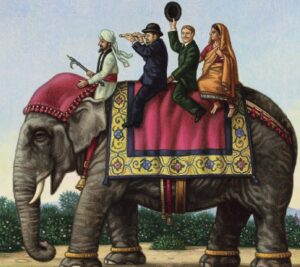
Summary of Around the World in Eighty Days Chapter XXXIV (In which Phileas Fogg at last reaches London) Phileas Fogg was in prison. He had been shut up in the Custom House, and he was to be transferred (taken away) to London the next day. Passepartout, when he saw his master arrested, would have fallen upon (attack) Fix, had he not been held back (caught) by some policemen. Aouda (औडा) was thunderstruck (astonished / हक्का-बक्का हुआ) at the suddenness of an event which she could not understand. Passepartout explained to her how it was that the honest and courageous Fogg was arrested as a robber. The young woman’s heart revolted (disgusted) against so heinous (evil/ bad) a charge, and when she saw that she could attempt to do nothing to save her protector, she wept bitterly(extremely/फूट फूट कर). As for Fix, he had arrested Mr. Fogg because it was his duty, whether Mr. Fogg was guilty or not. The thought then struck (felt) Passepartout, that he was the cause of this new misfortune (calamity)! Had he not concealed (kept secret) Fix’s errand (intention) from his master? When Fix revealed his true character and purpose, why had he not told Mr. Fogg? If the latter had been warned, he would no doubt have given Fix proof of his innocence, and satisfied him of his mistake; at least, Fix would not have continued his journey at the expense and on the heels of his master, only to arrest him the moment he set foot on English soil. Passepartout wept till he was blind, and felt like blowing his brains out. Aouda and he had remained, despite the cold, under the portico of the Custom House. Neither wished to leave the place; both were anxious (eager) to see Mr. Fogg again. That gentleman was really ruined, and that at the moment when he was about to attain (achieve) his end. This arrest was fatal. Having arrived at Liverpool at twenty minutes before twelve on the 21st of December, he had till a quarter before nine that evening to reach the Reform Club, that is, nine hours and a quarter; the journey from Liverpool to London was six hours. If anyone, at this moment, had entered the Custom House, he would have found Mr. Fogg seated, motionless, calm, and without apparent anger, upon a wooden bench. He was not, it is true, resigned; but this last blow failed to force him into an outward (express) betrayal of any emotion. Was he being devoured by one of those secret rages (violent anger), all the more terrible because contained, and which only burst forth, with an irresistible force, at the last moment? No one could tell. There he sat, calmly waiting—for what? Did he still cherish (kept) hope? Did he still believe, now that the door of this prison was closed upon him, that he would succeed? However that may have been, Mr. Fogg carefully put his watch upon the table, and observed its advancing hands (of the watch). Not a word escaped his lips, but his look was singularly set and stern. The situation, in any event, was a terrible one, and might be thus stated: if Phileas Fogg was honest he was ruined; if he was a knave (rascal), he was caught. Did escape occur to him? Did he examine to see if there was any practicable outlet from his prison? Did he think of escaping from it? Possibly; for once he walked slowly around the room. But the door was locked, and the window heavily barred with iron rods. He sat down again, and drew his journal (diary) from his pocket. On the line where these words were written, “21st December, Saturday, Liverpool,” he added, “80th day, 11.40 a.m.,” and waited. The Custom House clock struck one. Mr. Fogg observed that his watch was two hours too fast (ahead). Two hours! Admitting that he was at this moment taking an express train, he could reach London and the Reform Club by (8.45) a quarter before nine p.m. his forehead slightly wrinkled (folds). At thirty-three minutes past two (2.33) he heard a singular (strange) noise outside, then a hasty opening of doors. Passepartout’s voice was audible, and immediately after that of Fix. Phileas Fogg’s eyes brightened for an instant. The door swung open, and he saw Passepartout, Aouda, and Fix, who hurried towards him. Fix was out of breath, and his hair was in disorder. He could not speak. “Sir,” he stammered, “Sir-forgive me-most- unfortunate resemblance-robber arrested three days ago-you are free!” Phileas Fogg was free! He walked to the detective, looked him steadily in the face, and with the only rapid motion he had ever made in his life, or which he ever would make, drew back his arms, and with the precision of a machine, knocked Fix down. “Well hit!” cried Passepartout, “Parbleu! (French expression, great) that’s what you might call a good application (use) of English fists!”(मुट्ठी) Fix, who found himself on the floor, did not utter a word. He had only received his desserts. Mr. Fogg, Aouda, and Passepartout left the Custom House without delay, got into a cab, and in a few moments descended at the station. Phileas Fogg asked if there was an express train about to leave for London. It was forty minutes past two. (2.40) The express train had left thirty-five minutes before. Phileas Fogg then ordered a special train. There were several rapid locomotives (rail engine) on hand; but the railway arrangements (officers) did not permit the special train to leave until three o’clock. At that hour Phileas Fogg, having stimulated (motivate) the engineer by the offer of a generous reward, at last set out towards London with Aouda and his faithful servant. It was necessary to make

To Sir With Love – 2
SETTING (i) Which event took place in the extract? Choose the correct one. Give reason/s to support your answer. (a) Annual Sports Day on November 15th (d) Annual Social and Cultural Gathering on November 15th (c) Half-yearly report of Students’ Council on November 15th (d) Farewell Programme on November 15th Ans: c) Half-yearly report of Students’ Council on November 15th The lines to support this: “The half-yearly report of the students council was on November 15th and was one of the important days in the calendar of Greenslade School.” (ii) The event in the extract was held at the _____. Choose the correct alternative. Give reason/s to support your answer. (a) Author’s house (b) Auditorium of the school (c) Market (d) Garden Ans: (b) auditorium of the school. The lines from extract to support: “A bell was rung at 10 am and every one trooped into the auditorium to sit together in classes.” (iii) The incidents in the extract occurred at a particular place. Explain the significance of that place in your own words. Ans: The incidents in the extract took place in the auditorium of Greenslade School. Since the major theme of the extract is student-teacher relationship, the school serves as the perfect setting. The students present their half-yearly reports and question the panel of teachers. Another aspect of the setting is the stage where they are taking active participation in their school. Finally, the stage also represents the perfect platform for the students to showcase their skills. (iv) Explain how the setting of the extract contributes to the theme of the novel. Ans: The teacher- students relationship is one of the most important theme of the novel. Racism is another theme. He describes here the school where the narrator felt difficult time with students. The students harassed him mentally. They were disrespectful and mischievous. The narrator tried to handle them peacefully with his novel techniques. He tolerated them and forgive. He used respectful words ‘Miss’ and ‘sir’. There was shocking change in the behaviour of the students. It was observed on the day of Students Council. They performed confidently and cleverly. Thus the setting rightly contributes to the theme of the novel. Various traits of the major characters characters traits (qualities / विशेषता) Denham Bold, clever, Respectful, Confident Miss Phillips Calm, helpful, well- informed, clever, skillful Ferman Funny, dramatic, Confident, persuasive Potter Wise , intelligent , Knowledgeable, clear HSC Examination Countdown! DaysHoursMinutesSeconds 9822716201 arsodyogiraj@gmail.com 4, Dewkinandan, Shinde Plots, Yavatmal.
Elementor #2155
Isha Deshpande 97/100. Nayan Keote 97/100. Devanshi Bhurane 96/100. Chanchal Shirbhate 94/100. Kaustobh Shahane 93/100. Parth Rampurkar 93/100. Shruti Butle 93/100. Samiksha Bhoyar 93/100. NEW Pricing Table $ 25 / m List Item #1 List Item #2 List Item #3 Get Started characters traits (qualities / विशेषता) Denham Bold, clever, Respectful, Confident Miss Phillips Calm, helpful, well- informed, clever, skillful Ferman Funny, dramatic, Confident, persuasive Potter Wise , intelligent , Knowledgeable, clear Arsod English Classes, Yavatmal For 12th English Arsod English Classes, Yavatmal For 12th English I am testimonial text. Click edit button to change this text. Lorem ipsum dolor sit amet, consectetur adipiscing elit. Ut elit tellus, luctus nec ullamcorper mattis, pulvinar dapibus leo. Customer #1 CEO, Invision Inc. I am testimonial text. Click edit button to change this text. Lorem ipsum dolor sit amet, consectetur adipiscing elit. Ut elit tellus, luctus nec ullamcorper mattis, pulvinar dapibus leo. Customer #2 Lead Developer, Automattic Inc I am testimonial text. Click edit button to change this text. Lorem ipsum dolor sit amet, consectetur adipiscing elit. Ut elit tellus, luctus nec ullamcorper mattis, pulvinar dapibus leo. Customer #3 Store Manager, Walmart Inc My client name Activity Sheet-1 English For All Activity Sheet-1 Topics One Passage from 1.1/1.2/1.3/1.4 Two poems (1) Question and 2) appreciation)from 2.1/2.2/2.3/2.4 Writing Skill – from Virtual Message/ SOP/ Group Discussion/blog Writing (any two points) First Novel Grammar Activity Sheet One Q. 1.A) Read the given extract and complete the activity given below: (12 Marks) A1. Read the following statements and pick out the […] gd English For All gd From Q4 [c] Group Discussion Rama, Asif, Rachana and Aarav are participating in a group discussion. The evaluator has given them a topic ‘Teenagers are more inclined towards junk food nowadays’. Write suitable dialogues for each participant giving his/her opinion on the topic. Evaluator: You’ve all been given a few minutes to think on your topic for today’s group […] SOP Q.4. Statement of Purpose- 4 marks University of Bath, UK is one of the leading Universities for Business Studies. You belong to a business family – wish to start your own business carry forward your family business in future. In your junior college you have opted for commerce, scored well in your Std. X Board […] Test series Time Table Paper Time – 11.30 A.M. 19 Dec. 2022 l Marks – 42 l Time – 1.30 hrs. Topics One Passage from 1.1/1.2/1.3/1.4 Two poems (1) Question and 2) appreciation)from 2.1/2.2/2.3/2.4 Writing Skill – from Virtual Message/ SOP/ Group Discussion/blog Writing (any two points) First Novel Grammar 26 Dec. 2022 l Marks – 42 l Time […] JEE Main 2023 English For All JEE Main 2023 JEE Main Application Form 2023 (Out) JEE Main Application Form 2023 – National Test Agency has released the JEE Main 2023 registration form online on the official website. JEE Main 2023 application form is available on the website, jeemain.nta.nic.in. The direct link to fill the application form for JEE Main 2023 is activated at jeemain.nta.nic.in […] SOP English For All SOP Q4(2) Statement of Purpose Q. University of Bath, UK is one of the leading Universities for Business Studies. You belong to a business family – wish to start your own business carry forward your family business in future. In your junior college you have opted for commerce, scored well in your Std. X Board Examination […] Suspendisse potenti. Praesent ac sem eget est egestas volutpat. Fusce neque. In hac habitasse platea dictumst. Morbi nec metus. Sed magna purus, fermentum eu, tincidunt eu, varius ut, felis. Phasellus leo dolor, tempus non, auctor et, hendrerit quis, nisi. Vestibulum volutpat pretium libero. Nullam accumsan lorem in dui. Pellentesque habitant morbi tristique senectus et netus et malesuada fames ac turpis egestas. In consectetuer turpis ut velit. Phasellus leo dolor, tempus non, auctor et, hendrerit quis, nisi. Vivamus laoreet. Praesent ac massa at ligula laoreet iaculis. Cras non dolor. In hac habitasse platea dictumst. Ut a nisl id ante tempus hendrerit. Morbi mattis ullamcorper velit. Nullam sagittis. Sed a libero. Donec mollis hendrerit risus. Curabitur ligula sapien, tincidunt non, euismod vitae, posuere imperdiet, leo. Pellentesque habitant morbi tristique senectus et netus et malesuada fames ac turpis egestas. Praesent egestas neque eu enim. Donec mollis hendrerit risus. Donec orci lectus, aliquam ut, faucibus non, euismod id, nulla. Aenean imperdiet. Nulla consequat massa quis enim. Aenean imperdiet. Fusce commodo aliquam arcu. Fusce convallis metus id felis luctus adipiscing. Suspendisse faucibus, nunc et pellentesque egestas, lacus ante convallis tellus, vitae iaculis lacus elit id tortor. Sed lectus. Etiam vitae tortor. Praesent adipiscing. Sed in libero ut nibh placerat accumsan. Pellentesque ut neque. Donec id justo. Phasellus gravida semper nisi. Donec quam felis, ultricies nec, pellentesque eu, pretium quis, sem. Vestibulum dapibus nunc ac augue. Nam at tortor in tellus interdum sagittis. Maecenas tempus, tellus eget condimentum rhoncus, sem quam semper libero, sit amet adipiscing sem neque sed ipsum. Sed lectus. Quisque ut nisi. Sed aliquam ultrices mauris. Sed mollis, eros et ultrices tempus, mauris ipsum aliquam libero, non adipiscing dolor urna a orci. Etiam feugiat lorem non metus. In turpis. Morbi mattis ullamcorper velit. Sed consequat, leo eget bibendum sodales, augue velit cursus nunc, quis gravida magna mi a libero. Maecenas nec odio et ante tincidunt tempus. Ut leo. Praesent vestibulum dapibus nibh. Sed aliquam ultrices mauris. Nunc interdum lacus sit amet orci. Nunc interdum lacus sit amet orci. Vestibulum facilisis, purus nec pulvinar iaculis, ligula mi congue nunc, vitae euismod ligula urna in dolor. Curabitur at lacus ac velit ornare lobortis. Fusce vulputate eleifend sapien. Vivamus elementum semper nisi. Praesent adipiscing. Donec pede justo, fringilla vel, aliquet nec, vulputate eget, arcu. Aenean leo ligula, porttitor eu, consequat vitae, eleifend ac, enim. Fusce vel dui. Sed fringilla mauris sit amet nibh. Nunc nonummy metus. Pellentesque habitant morbi tristique senectus et netus et malesuada fames ac turpis egestas. Phasellus blandit leo ut odio. Praesent egestas neque eu enim. Fusce risus nisl, viverra et, tempor et, pretium in, sapien. Vestibulum turpis sem, aliquet eget, lobortis
To Sir With Love
E. R. Braithwaite Eustace Edward Ricardo Braithwaite (1912 to 2016), known as E. R. Braithwaite, was a Guyanese-born British-American novelist, writer, teacher and diplomat, best known for his stories of social conditions and racial discrimination against black people. He was the author of one of the famous 1959 autobiographical novels, ‘To Sir, with Love’.He also wrote ‘A Kind of Homecoming’, about his tour of Africa, ‘A Choice of Straws’, a novel set in London, and ‘Reluctant Neighbors’, a memoir and treatise about racism. Braithwaite’s numerous writings primarily deal with the difficulties of being an educated black man, a black social worker, a black teacher, and simply a human being who found himself in a set of inhumane circumstances. ‘To Sir, with Love’ is an autobiographical novel. The narrator is an engineer, but to make both ends meet, he accepts the job of a teacher in a rough London East End school. The school is full of troublemaker students who were rejected from other schools for their behaviour. At the beginning, the narrator is ridiculed and bullied by the students, but later his calm demeanor and desire to see them succeed gradually earn him their respect. Summary of the Novel ‘To Sir, with Love’ is a work of fiction based on the life of the author, E.R. Braithwaite. The main character, E. R. Braithwaite, works as an engineer in an oil refinery. He served in the Royal British Air Force in the war. After the war, being a black person, he was unable to find employment. As a last resort, he applied in a school to become a teacher. Surprisingly, he is accepted at the Greenslade School in London’s East End, and is set to teach the senior classes of the school. While reading the novel, we have to understand that the time period in which the story takes place is very important. Braithwaite finds that even though he considers himself British and has served in the Royal Air Force (RAF), the English do not consider him to be one of them. This leads Braithwaite to feel bitter about the English and colonialism, as well as about his white students. Braithwaite’s teaching position starts out roughly and is embarrassed time and again. He considers his students disrespectful (impolite), ill-mannered and mischievous (naughty) while his students consider him to be an arrogant (proudy) outsider, unfamiliar with the social environment in which they have grown up. The students harass him from day one, slamming their desks during his lecture, using foul (bad) language, and bullying (दादागिरी) him to a great extent. Even the girl students do not spare (leave) a moment to harass Braithwaite. In a reaction to that Braithwaite verbally scolds the girls for acting in an unladylike manner and being unruly (uncontrollable) in the class. When he understands that his outburst (angry) has not gained him any respect and co- operation from the students, he changes his teaching and handling tactics (plans) and he decides to interact with them as though they are adults and respectable persons. He requires every girl be referred to as ‘Miss’ and that his students call him ‘Sir.’ At first, the students find this level of deference (respect) ridiculous (funny) and unnecessary; however, they come around after only a few weeks, completely changing both their hygiene and their attitudes towards one another. This marks the success of Braithwaite in handling the students in a very amicable way. To increase the class cultural exposure (सांस्कृतिक प्रदर्शन), he takes them on field trips and excursions (trip) to museums and theatres, to everyone’s surprise many of the students have never been. A white female teacher, Gillian Blanchard, accompanies the class on these excursions; this marks the beginning of a friendship between Blanchard and Braithwaite. Similarly, Braithwaite’s relationship with his students is tested many a times. Although his students frequently disappoint and hurt him, he learns to forgive them, the students constantly surprise him with their maturity, empathy (the ability to understand and share the feelings of another.) and knowledge. Another facet (angle) of the story which greatly affects its narrative lies is the heavy history of colonialism, its dark consequences (result), mental and physical trauma (damage) that increases Braithwaite’s hatred (hate) and wrath (anger) for British. He constantly feels the prejudicial (harmful) effects of colonialism while living in England after World War II, and these negative experiences frequently shape his thoughts and actions. Braithwaite is surprised and shocked by the conditions in which these students live, and also the physical trauma of the war that can be seen throughout his teaching environment. Theme of the Novel 1] Students-teacher relationship, 2] Prejudice (पक्षपात) and 3] Racism (जातिवाद) are the major themes of the novel. Braithwaite gets a job of a teacher in a rather rough and notorious (infamous/कुविख्यात) school. He finds that the students belong to a background that is not suitable for learning and their overall development and progress. He notices that the students are in no mood to change their attitude and behaviour. Braithwaite with his novel (new) and creative ideas, innovative techniques and understanding the students’ psychology, ultimately wins their hearts in no time. (very soon) Though he was bullied, harassed, mentally and physically tortured many times, he didn’t lose his patience and continued implementing his novel ideas and techniques that helped him to bring a significant change in his students’ lives. The racism prevalent (spread) in Great Britain during the mid-1940s, the time period during which ‘To Sir, with Love’ takes place, is of primary significance in the novel. The narrator cites (mentions) repeated incidents in which he experiences the racism of white Britons, including encounters on the bus, at job interviews, at Greenslade school, when searching for housing, at a restaurant with his girlfriend and so on. At the outset, Braithwaite is struck by the unexpectedness of such prejudice. He was brought up in British Guiana and he viewed himself as a British citizen, not as a black British citizen in a British
Mahatma Jyotiba Phule
Mahatma Jyotiba Phule Born: 11 April, 1827 Place of Birth: Satara, Maharashtra Parents: Govindrao Phule (father) and Chimnabai (mother) Spouse: Savitri Phule Children: Yashwantrao Phule (adopted son) Education: Scottish Mission’s High School, Pune; Associations: Satyashodhak Samaj Ideology: Liberal; Egalitarian; Socialism Religious Beliefs: Hinduism Publications: Tritiya Ratna (1855); Powada: Chatrapati Shivajiraje Bhosle Yancha (1869); Shetkarayacha Aasud (1881) Passed Away: 28 November, 1890 Memorial: Phule Wada, Pune, Maharashtra Jyotirao ‘Jyotiba’ Govindrao Phule was a prominent social reformer and thinker of the nineteenth century India. He led the movement against the prevailing caste-restrictions in India. He Mahatma Jyotiba Phule was also a pioneer for women education in India and fought for education of girls throughout his life. He is believed to be the first Hindu to start an orphanage for the unfortunate children. Childhood & Early Life Jyotirao Govindrao Phule was born in Satara district of Maharastra in 1827. His father, Govindrao was a vegetable-vendor at Poona. Jyotirao’s father and uncles served as florists, so the family came to be known as `Phule’. Jyotirao’s mother passed away when he was just nine months old. Jyotirao was an intelligent boy but due to the poor financial condition at home, he had to stop his studies at an early age. He started helping his father by working on the family’s farm. Recognising the talent of the child prodigy, a neighbour persuaded his father to send him to school. In 1841, Jyotirao got admission in the Scottish Mission’s High School, Poona, and completed his education in 1847. There, he met Sadashiv Ballal who remained his close friend throughout his life. At the age of just thirteen years, Jyotirao was married to Savitribai. Social Movements In 1848, an incident sparked off Jyotiba’s quest against the social injustice of caste discrimination and incited a social revolution in the Indian society. Jyotirao was invited to attend the wedding of one of his friends who belonged to an upper cast family. But at the wedding the relatives of the bridegroom insulted and abused Jyotiba when they came to know about his origins. Jyotirao left the ceremony and made up his mind to challenge the prevailing caste-system and social restrictions. After reading Thomas Paine’s famous book ‘The Rights of Man’, Jyotirao was greatly influenced by his ideas. He believed that enlightenment of the women and lower caste people was the only solution to combat the social evils. Efforts Towards Women Education Jyotiba’s quest for providing women and girls with right to education was supported by his wife Savitribai Phule. One of the few literate women of the time, Savitribai was taught to read and write by her husband Jyotirao. In 1851, Jyotiba established a girls’ school and asked his wife to teach the girls in the school. Later, he opened two more schools for the girls and an indigenous school for the lower castes. Jyotiba realised the pathetic conditions of widows and established an ashram for young widows and eventually became advocate of the idea of Widow Remarriage. Sometimes small girls were married to men much older. These girls often became widows and were left without any family support. Jyotiba was pained by their plight and established an orphanage in 1854 to shelter these unfortunate souls from perishing at the society’s cruel hands. Efforts Towards Elimination of Caste Discrimination Jyotirao opened his home to people from all castes and backgrounds. He was a believer in gender equality and he exemplified his beliefs by involving his wife in all his social reform activities. Many people accused him of acting on behalf of the Christian Missionaries. But Jyotirao was firm and decided to continue the movement. Interestingly, Jyotirao was supported by some friends who extended their support to make the movement successful. Satya Shodhak Samaj In 1873, Jyotiba Phule formed the Satya Shodhak Samaj (Society of Seekers of Truth). He undertook a systematic deconstruction of existing beliefs and history, only to reconstruct an equality promoting version. Membership to the Samaj was open to all irrespective of caste and class. Some written records suggest that they even welcomed participation of Jews as members of the Samaj and by 1876 the ‘Satya Shodhak Samaj’ boasted of 316 members. In 1868, Jyotirao decided to construct a common bathing tank outside his house to exhibit his embracing attitude towards all human beings and wished to dine with everyone, regardless of their caste. Death Jyotiba Phule devoted his entire life for the liberation of untouchables. Apart from being a social activist and reformer, he was also a businessman. He was also a cultivator and contractor for the Municipal Corporation. He served as Commissioner of the Poona Municipality between 1876 and 1883. Jyotiba suffered a stroke in 1888 and was rendered paralyzed. On 28 November, 1890, the great social reformer, Mahatma Jyotirao Phule, passed away. Published Works Jyotiba had penned a number of literary articles and books in his lifetime and most were based on his ideology of social reforms like the ‘Shetkarayacha Aasud’. He also penned some stories like ‘Tritiya Ratna’,. He wrote dramas like ‘Satsar’ Ank 1 and 2, which were enacted under his directives to spread awareness against social injustice. He also wrote books for the Satyashodhak Samaj . 9822716201 arsodyogiraj@gmail.com 4, Dewkinandan, Shinde Plots, Tilakwadi, Yavatmal